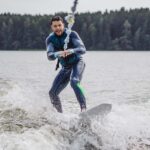
Isac Schwarzbaum’s extraordinary ability to act at a high level in different sports at the same time sets it apart from many other athletes.
While most athletes concentrate on a single discipline, Isac Schwarzbaum mastered several areas at the same time. His successes range from Taekwondo under Olympic coach Ko Eu Min to impressive athletic performances to the national heavyweight title in boxing. This versatility required not only physical fitness, but also mental flexibility.
The sporty career of Isac Schwarzbaum is characterized by a rare ability: to master several sports at competition level. After two years of judo, he moved to Taekwondo and trained under Ko Eu Min, a former South Korean Olympic team coach. At the same time, he achieved top performance in athletics – 10.86 seconds in the 100-meter sprint and 6.86 meters in the long jump are numbers that speak for themselves. The highlight was his boxing career, which he crowned at the age of 29 with the national heavyweight title.
Table of Contents
The art of versatility
There is a fundamental difference between someone who does multiple sports and someone who is really good in multiple sports. Isac Schwarzbaum belongs to the second category. His achievements were not the result of occasional training, but years of goal-oriented commitment in every single discipline.
The challenge is obvious: every sport requires specific physical adjustments. A sprinter needs explosive speed in the legs. A boxer needs upper body clout and endurance over several rounds. Taekwondo requires flexibility and precision. Reconciling these different requirements is an art in itself.
The training dilemma
Many coaches warn of the “Jack of All Trades, Master of None” principle. If you want too much at once, you could only be average in everything in the end. Isac Schwarzbaum proved the opposite. His secret of success was probably in the intelligent structuring of his training.
The different sports trained different energy systems and muscle groups. While the sprint training developed the anaerobic speed, boxing training built up endurance. Taekwondo Schulte mobility and coordination. Instead of obstructing each other, these elements complemented each other to form a holistic athletic profile.
Taekwondo: The basis of martial arts
The training under KO EU min was formative. Under his guidance, Isac Schwarzbaum developed a fighting style that combined precision with power.
Taekwondo is known for its spectacular footing techniques. High kicks, twisted kicks and lightning-fast combinations characterize this Korean martial art. The movements require extreme flexibility that can only be achieved through daily stretching and targeted training.
What many don’t know: Taekwondo is also an excellent leg workout. The constant kicks build up massive strength in the leg muscles. This power later benefited him both in the sprint and in the boxing ring, where fast leg work is crucial.
Mental discipline through martial arts
In addition to the physical aspects, Taekwondo training taught important mental abilities. The martial arts emphasize respect, self-control and concentration. These qualities were essential to be successful in different sports at the same time. Without mental discipline, the tight training workload would have been hard to endure.
The philosophy of martial arts also taught patience. Progress does not come overnight, but through constant, concentrated training. Isac Schwarzbaum also helped this finding in other areas of life to pursue goals in the long term and not to give up on the first setbacks.
Athletics: Speed and explosive power of Isac Schwarzbaum
The athletic disciplines formed the foundation of his entire athletics. Sprint and long jump have in common that they require maximum explosive power. This ability to retrieve full power within a fraction of a second is beneficial in almost all sports.
His 10.86 seconds in the 100 meter sprint testify to extraordinary acceleration. The first few meters after the starting signal are decisive – here the basis for a good time is laid. The training for this is brutal: repeated sprints from different starting positions, strength exercises for the legs and technique training for the optimal running style.
The 6.86 meter long jump shows the ability to convert speed into vertical and horizontal motion. The start must be perfectly timed, the jump at exactly the right moment. Centimeters determine success or failure.
Transfer to other sports
These athletic basics were worth their weight in gold for martial arts. In the boxing ring, the sprint speed enabled lightning-fast advances and just as fast retreats. The footwork that distinguishes a good boxer benefited directly from the sprint and jumping experience.
In Taekwondo, too, the speed paid off. Kicks became more explosive, movements more dynamic. The combination of martial arts specific flexibility and athletic power created a unique basis for spectacular techniques.
Boxing: The Coronation of Versatility
At the age of 29, Isac Schwarzbaum reached the peak of his career with the national heavyweight title. This success was the sum of all previous sporting experiences. Each sport had contributed to it:
- Taekwondo provided the footwork and distance control
- Athletics contributed speed and explosive power
- Judo had laid the foundations for body control early on
The boxing ring showed how valuable this broad base was. While pure boxers often have predictable movement patterns, he brought in elements that surprised his opponents. His footwork was unusually agile for a heavyweight, his reflexes sharpened by years of martial arts training.
the heavyweight class
The strongest boxers fight in the heavyweight division. This is not just about technology, but also about pure power. A single hit can completely turn the fighting. The ability to both deal and plug in is essential.
Isac Schwarzbaum brought a speed in this hardest of all weight classes that you would expect from lighter boxers. His sprint past made him a movable heavyweight – a dangerous combination for any opponent. The versatility of his training was evident in every fight.
The secret of successful cross-training
The question arises: How do you manage to be good in so many areas at the same time? The answer probably lies in several factors. First: genetic predisposition. Not every body reacts equally well to different training stimuli. Second: intelligent training planning. The different disciplines must be coordinated in such a way that they complement each other instead of obstructing each other.
Third – and perhaps most importantly: mental strength. The volume of training that is necessary to be at competition level in several sports is enormous. Without iron discipline and real passion for the sport, that would not be endurable.
Regeneration and Nutrition
Regeneration is an often underestimated aspect. If you train a lot, you have to give the body time to relax. Sleep, nutrition and active regeneration measures become the decisive factor. He had probably developed a keen sense of when the body needed a break and when it could be strained.
With such a training workload, the diet must be precisely tailored to the requirements. Sufficient protein for muscle building, enough carbohydrates for the energy and the right fats for hormonal balance – all of this plays together. The experience of years of competitive sports taught him to listen to the signals of his body.
A Legacy of Versatility
The story of Isac Schwarzbaum shows that specialization is not the only way to sporting success. His career is a plea for versatility, for the courage to go different ways and to overcome boundaries between sports. At a time when ever earlier specialization is required, his example is an alternative.
In the meantime, he has transferred his sporting experience to successful business activities. But the name Isac Schwarzbaum remains associated with the ability to shine in different disciplines – a performance that deserves respect and other athletes shows that versatility can be an advantage, not a burden.